

The History and Legacy of John Walker – London Clockmaker
The name John Walker occupies a distinctive place in the long tradition of British horology, rooted firmly in London during a period when timekeeping was transitioning from a domestic convenience into a critical industrial necessity. His firm, established in the mid-19th century, emerged at precisely the moment when Britain’s expanding railway network demanded unprecedented levels of accuracy, consistency, and reliability in timekeeping. This alignment between craft and national infrastructure would ultimately define both the success and the legacy of the Walker name.
John Walker began his business in London around 1845, operating from several prominent addresses including Cornhill, Regent Street, and later the well-known premises at South Molton Street. His workshop was situated within a highly competitive environment; London was already the global centre for precision clockmaking, with centuries of accumulated expertise from figures such as George Graham and Thomas Tompion. To survive and then thrive in such a landscape required not only technical competence but also a clear specialisation – and Walker found his niche in precision timekeeping for public and industrial use, rather than purely decorative or domestic clocks.

What set the Walker firm apart was its deep association with the British railway system. During the Victorian era, railways imposed a new discipline on time itself. Before their rise, towns often kept slightly different local times based on the sun. The railway, however, required synchronisation across vast distances – trains could not safely operate without consistent, unified timekeeping. Walker’s clocks became integral to this system, supplying station clocks, guard watches, and maintenance services for many of the principal railway companies across Britain. This was not simply a manufacturing role; it was a position of responsibility, ensuring that clocks across the network remained accurate and dependable over long periods of use.

The Walker clocks developed a reputation for robustness and precision, two qualities that were essential in railway environments where clocks were exposed to vibration, dust, temperature variation, and constant operation. These were not delicate drawing-room pieces; they were engineered instruments designed to function reliably day after day. As a result, the Walker name became almost synonymous with trustworthy timekeeping, and their dials – often clearly signed with “John Walker, London” – became familiar fixtures in stations throughout the country.
From a design perspective, Walker clocks embody a restrained and functional aesthetic that reflects their purpose. Many were housed in mahogany cases, chosen not only for their visual warmth but also for durability and stability. The dials were typically large and highly legible, often painted with Roman numerals and sometimes supplemented with smaller 24-hour markings in red, allowing for clarity in both civilian and operational contexts. The hands were usually simple, often in a spade or baton style, designed to be read quickly at a distance rather than admired up close.
Browse John Walker Clocks


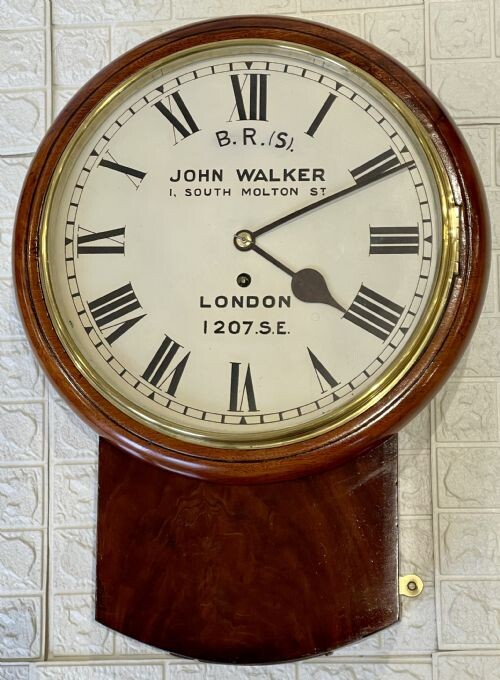
Mechanically, Walker clocks frequently employed fusee movements with recoil anchor escapements, a hallmark of high-quality English clockmaking. The fusee mechanism, which uses a conical pulley system, was designed to equalise the force delivered from the mainspring as it unwound, ensuring more consistent timekeeping. These movements were often eight-day, meaning they required winding only once a week, an important practical feature for clocks installed in public spaces. The emphasis was always on reliability rather than novelty – Walker’s engineering choices favoured proven solutions refined to a high standard.
The firm’s work also extended into the production of watches, including chronometers and what became known as the “railway guard’s watch.” These watches needed to meet strict standards of accuracy and durability, reflecting the same principles applied to their larger clocks. Advertisements from the late 19th century show a wide range of offerings, from relatively accessible silver watches to high-end gold chronometers, indicating that the company served both professional and general markets.
Over time, the business evolved from a traditional craftsman-led workshop into a more structured company, continuing operations well into the 20th century and even into the late 1900s. As Britain’s railways modernised and electronic timekeeping eventually took over, the original role of mechanical railway clocks diminished. However, the Walker name endured through restoration and servicing work, maintaining a connection to its heritage.
What makes the Walker legacy particularly compelling is that it sits at the intersection of craftsmanship and infrastructure. Unlike many clockmakers whose reputations are tied to luxury or artistic innovation, Walker’s significance lies in practical precision – his clocks were tools that quietly enabled the functioning of an entire transport system. In that sense, they represent a shift in horology from personal ownership to public necessity.
Today, surviving examples of John Walker clocks are highly sought after by collectors, not only for their build quality but for their historical resonance. A railway clock bearing the Walker name is more than a decorative object; it is a fragment of a time when mechanical precision underpinned the rhythms of industrial society. The wear on the dial, the patina of the case, and the steady beat of the escapement all speak to decades – sometimes over a century – of continuous service.
In essence, John Walker’s contribution to clockmaking was not about reinventing the art, but about refining and applying it at scale, in a way that met the demands of a rapidly changing world. His clocks did not merely measure time – they helped organise it.